







The Software Factory Engineer
The cohort class · 180 lessons
Classes taken by students working at…










Let’s talk about what actually changed when agents started writing all the code, and why the hard part of your job didn’t go away. It moved.
Here’s the honest version. Generation is solved. Not perfect, but solved in the way that matters: the agent writes the change, runs the tests and opens the PR before your coffee break is over.
What isn’t solved is knowing that what came back is right. And right now, that job is yours. Code got cheap. You can run ten agents at once. Your attention is a few good hours a day, and no model release gives you more hours. If anything, every release makes the gap wider: the agents get faster, and you stay almost the same speed.
Which is good news, honestly. This is why engineers still matter. Agents are fast, but they have no idea what “correct” means for your product. You do. That judgement is the job now. But most of our hours go on checking the agent’s work by hand, not on deciding what “correct” should be.
And if this year feels like starting over, that’s the job. Software pays the way it does because it keeps changing, and the engineers who learn the new way first are the ones it rewards.
If you just sit down and start shipping with agents, you end up spending your attention in the wrong places. You turn into one of three people:
Not to mention the waste. Hours spent reading code that turns out to be fine, while the one bug that mattered slips through anyway.
But none of this is a character flaw. It’s a budget problem, and budget problems have engineering answers.
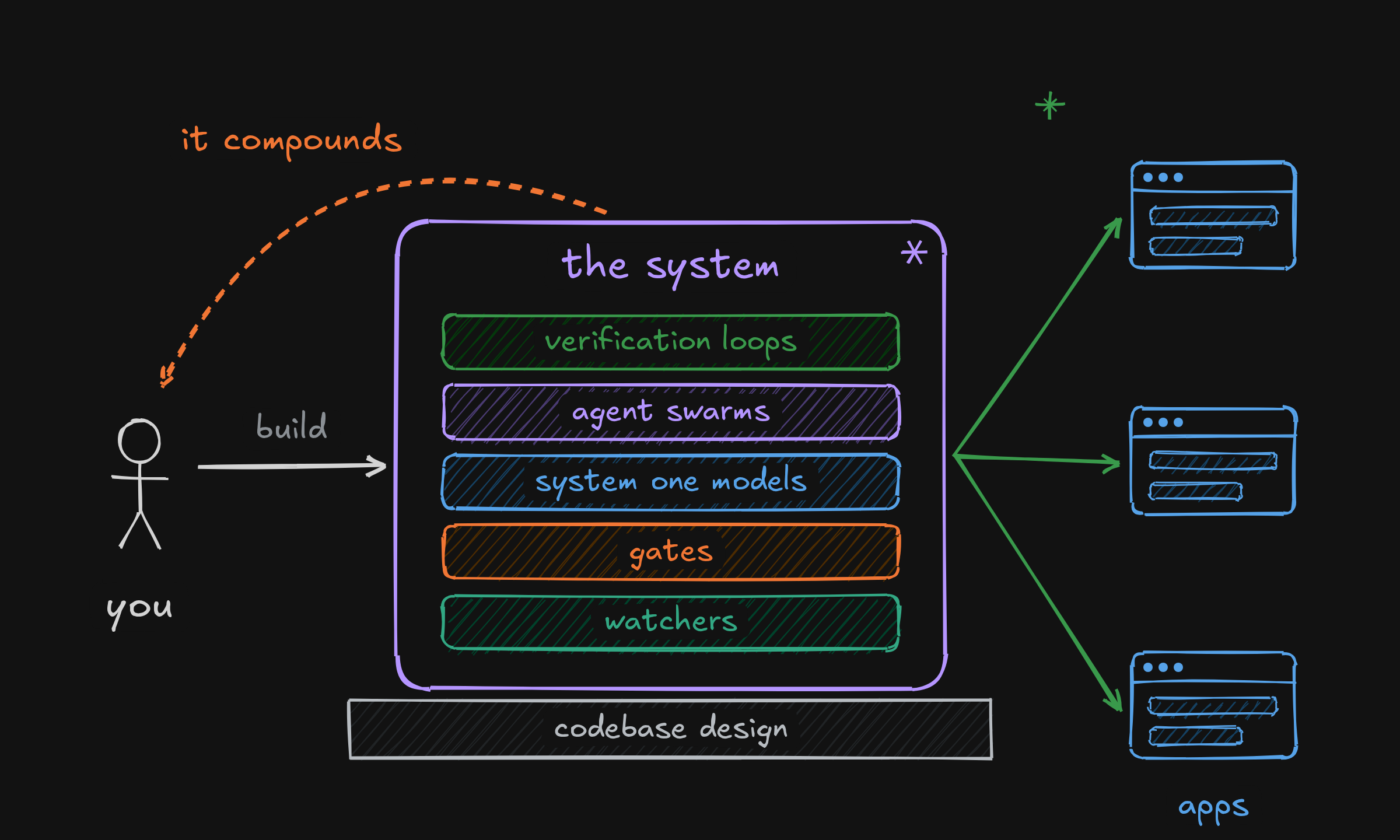
Here’s the shift that changed how I work. Your job isn’t the application any more. Your job is the system that builds the application: the agents, the checks, the gates, the rules they all follow. You build that. It builds everything else.
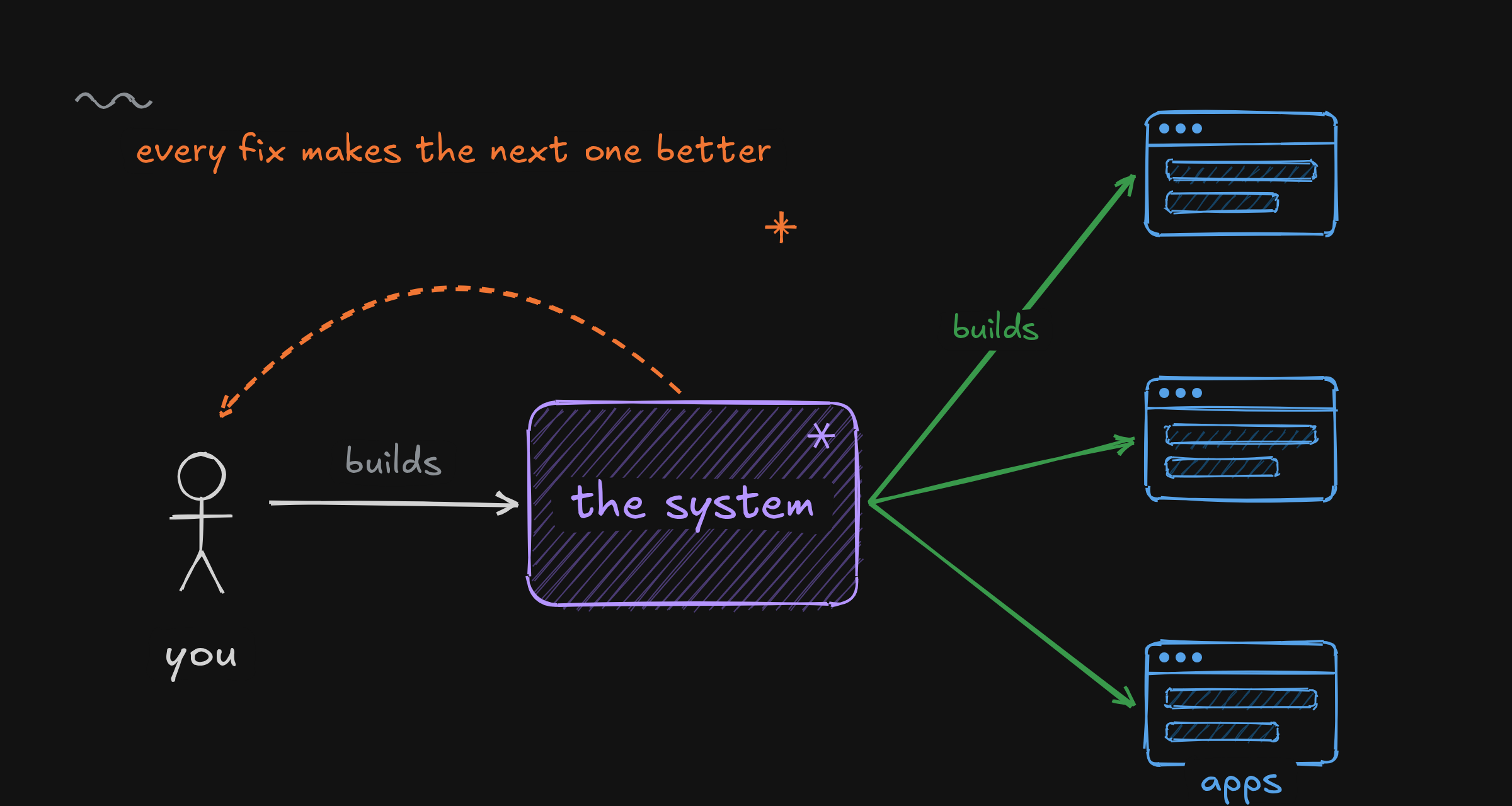
When you fix a bug in an app, you’ve fixed one bug in one app.
When you fix it in the system, as a lint rule, a verifier, a new way to attack a change, every app it builds gets that fix. Today, tomorrow, and on code that hasn’t been written yet.
Work on the app is spent the moment you do it. Work on the system keeps paying dividends.
For about a year, I was the Proofreader. I read every diff my agents wrote, and I told myself that was being careful.
Every problem I caught, I caught by hand, and the next day the agent made it again somewhere else. None of that care compounded. And all of it happened before the merge. After the merge, nobody was looking at all.
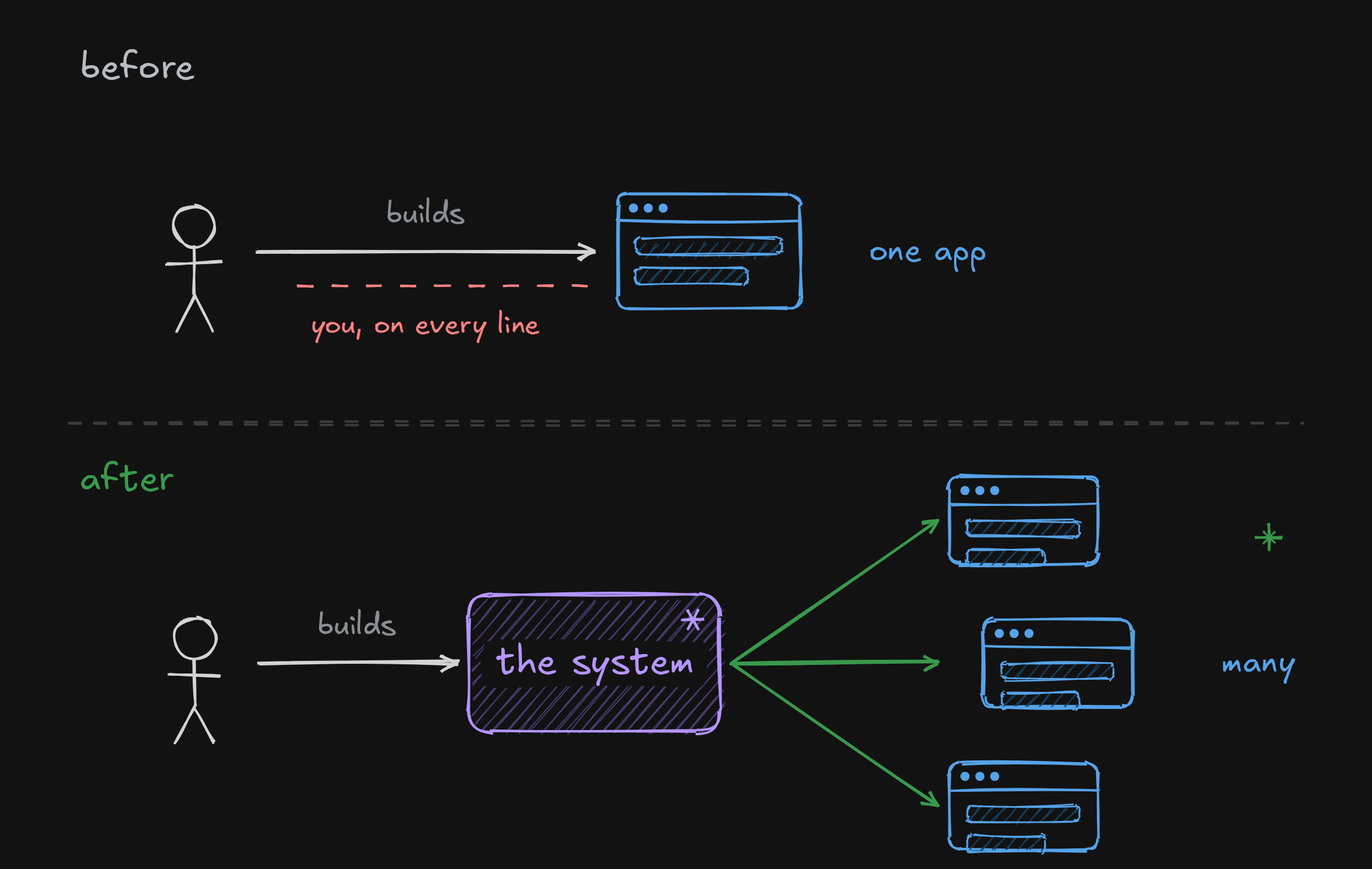
So I stopped fixing apps and started fixing the system. Spending tokens instead of afternoons. Once that was running, it turned out I could:
And not on a toy project. On real codebases that are years old, with companies that depend on them, with a token budget, where other people’s work is landing at the same time as mine.
Agents pick up a ticket, write the code, open the PR. That part works. But most factories stop at the merge button. The ticket closes, the code goes out into the world, and nobody is watching it.
The one I’m going to teach you keeps going. It checks the work against reality, holds the risky changes for you, and keeps watching after it ships. It’s built from parts you’ll make yourself:
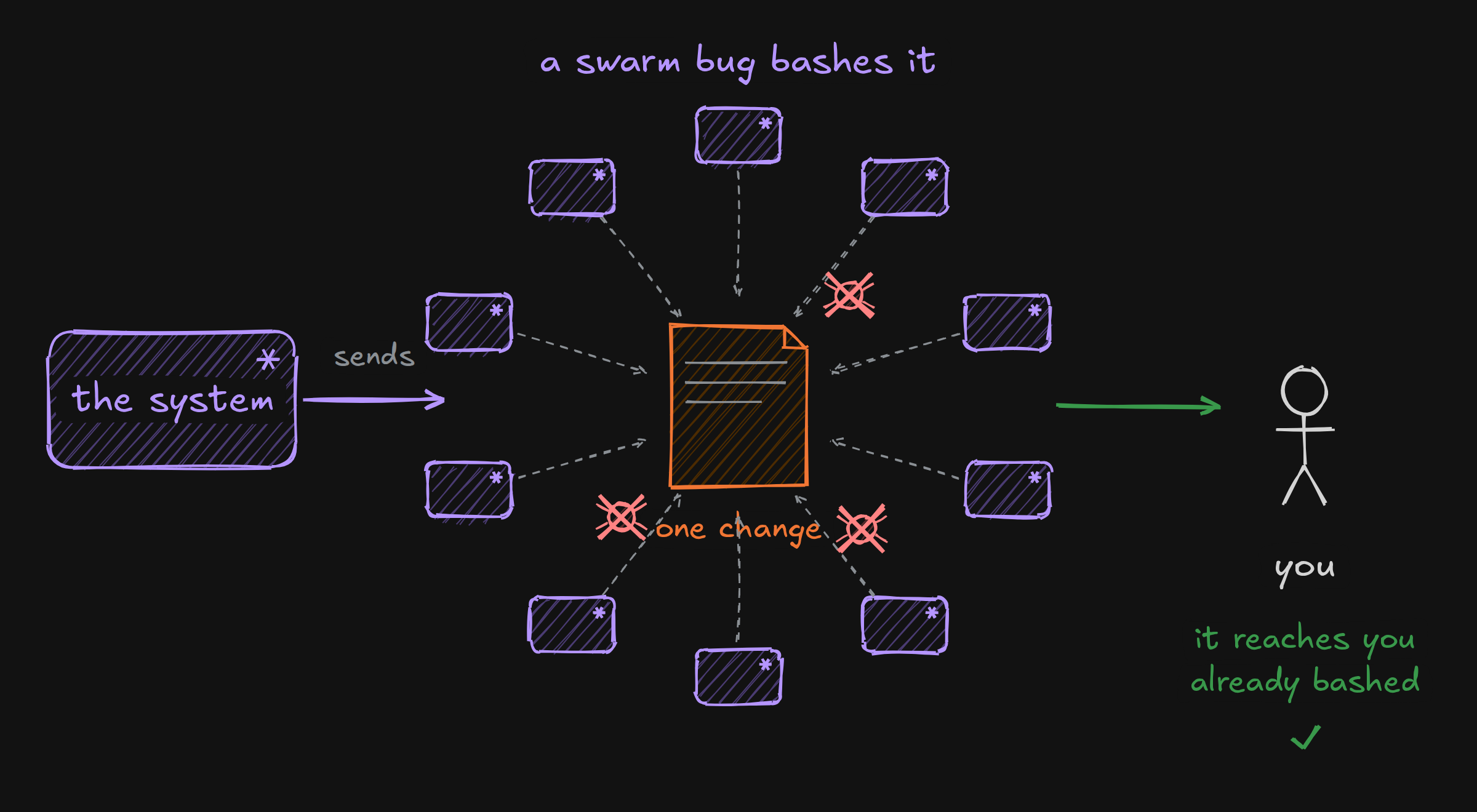
This is the part that feels like cheating. Before a big change gets anywhere near you, the system sends a swarm at it. One agent clicks through it like a new user. One feeds it garbage input to see what falls over. One plays the attacker and tries to break it on purpose, and it’s built not to just agree with the code it’s attacking.
So go back to those three people from earlier. Here’s what changes for each.
| Without it | With it | Fixed by | |
|---|---|---|---|
| The Proofreader | Reading every diff, skimming an hour in | Reading outcomes, and only the diffs that can hurt | The gate |
| The Human Test Suite | Clicking through it yourself, again | A swarm that clicked through it before you saw it | Agent swarms |
| The Last to Know | Hearing it from a customer | Hearing it from an agent first | Watchers |
Waiting for a better model. A better model writes faster. That widens the gap, it doesn’t close it.
More rules in CLAUDE.md. You wrote the rule, the agent ignored it on Thursday, and you wrote it again in capitals. An instruction is hope. A check that runs and fails doesn’t need to be remembered, and it never stops working.
Reading harder. You can’t out-read a machine. Skimming just feels like checking, and nothing you read today makes tomorrow’s reading any shorter.
The answer isn’t a setting or a plugin. It’s a system you design, the same way you’d design any other part of your product. And designing systems is still the job.
That’s what the next two weeks are for. You’ll build that system, one part at a time, and leave with it running.
It runs for two weeks, starting Mon 9 November. Week 1 goes from intake to a running loop. Week 2 goes from verification to the software factory. The lessons are recorded so you can watch them when it suits you, with live office hours on Tuesdays and Thursdays, each run twice for two time zones.
Almost all the attention goes before the merge. After the merge, the code meets real users and real data, and that’s where it actually breaks. The system you build here watches that side too, and when something does break, it doesn’t just tell you. It learns from it. The bug becomes a regression check, the mistake becomes an invariant or a decision record the agents read next time, and the verifiers that went quiet get re-graded before you trust them again.
Here’s what a normal day looks like once it’s running. You hand work off in the morning. You look at what the gate held for you. You hear about the one thing that broke from an agent, not a customer. And by the evening, the system is a little better than it was this morning, which means so is everything it builds tomorrow.
Here’s everything we’ll cover.
The lifecycle, in the order the work moves through it, now with system one models and agent swarms. Each stage hands to the next, and the last one hands back to the first.
Taught 4,000+ Engineers. Ex-YC Technical Founder. Cambridge Physics.
I’m an engineer shipping real products with Claude Code & Codex. Since the AI coding tools launched I have put 5,000+ hours into using them, building 21 Dreams (my holding company that builds agent-first software) and creating the most in-depth Claude Code content on YouTube.
The workflows I teach come from production work, not a content calendar, which is why they tend to go mainstream months after I cover them. As such people learning from them feel months ahead of the curve.
This class is those 5,000+ hours concentrated: everything I know about shipping production-grade code with agents. My teaching style comes from my undergraduate Physics degree at Cambridge, so I teach fundamentals-first and pair every concept with the problem it solves, helping you build real intuition for a fast moving world.





The cohort class · 180 lessons
Evergreen, with ongoing updates
Evergreen, with ongoing updates
Two time zones. Every session recorded.
What changed, and what’s worth using.
For your employer or LinkedIn.
Members get the Zoom link on their dashboard.Bring your questions to the session, or join the session and ask live on Zoom.
Members get the Zoom link on their dashboard.Bring your questions to the session, or join the session and ask live on Zoom.
Members get the Zoom link on their dashboard.Bring your questions to the session, or join the session and ask live on Zoom.
Members get the Zoom link on their dashboard.Bring your questions to the session, or join the session and ask live on Zoom.
Members get the Zoom link on their dashboard.Bring your questions to the session, or join the session and ask live on Zoom.
Members get the Zoom link on their dashboard.Bring your questions to the session, or join the session and ask live on Zoom.
From students of my classes.
The Agentic Coding School doesn't just show you what buttons to press, it builds genuine understanding from the ground up. By the time you're two-thirds through, you're not just using the tool, you're thinking in it.
This is not the typical get-rich-quick hustle program you see on social media. Ray works deep in the inner workings of the models and knows how to be productive with them. I am convinced he uses Claude Code as well as or better than most Anthropic engineers.
I went from treating Claude Code like a chatbot to running it like a full development platform. The lessons on hooks, subagents, and CLAUDE.md files alone were worth it.
I already had experience with Claude Code, and this still took me further. Seeing your everyday usage throughout the course is genuinely valuable, not just some vibe coding app. I learned a lot from the multi-agent plan execution and the spec-dev command.
Saved me hours of headaches with deployments, and he's on top of everything. It's crazy since he's up to date and only releases videos if they're relevant, so has been super helpful for my workflow as a solo founder.
I'm only just getting started, but the course is so practical and well-designed that I saw immediate improvements in my own agentic coding workflow. I can't wait to spend this weekend finishing a bigger chunk of the course.
It’s too early for you if:
About 5½ to 6 hours of lessons a week, plus up to 4 hours of optional office hours.
The lessons are pre-recorded, so you watch them when it suits you.
A 30-day money-back guarantee, one refund per customer.
The 30 days count from the day the cohort starts, not the day you buy. So the earlier you buy, the longer you have:
Cohort 3 starts Mon 9 November, so whenever you buy, you can ask for a refund until Wed 9 December.
It doesn’t matter how much you’ve watched or how many live sessions you’ve joined, as long as you haven’t tried to download, scrape or rip the videos.
Email us at r@rayamjad.com before your window ends. The full terms are on the refund policy page.
Yes. Over 80% of people have their company pay for it, so ask your boss before you pay yourself.
/expense writes that email for you. It also covers what finance and L&D usually ask for next: the receipt and the certificate of completion.
If your finance team needs something specific on the invoice, email us at r@rayamjad.com.
We don't offer discounts for individuals. Only team plans.
You stop reading every diff, and you still trust what ships. You’ll know how to use:
Every one is built on our own products. Along the way you build your own Slack agent that opens pull requests. For a team lead, it becomes how your whole team ships with agents.
Yes, with a volume discount that grows with the number of seats.
While enrolment is open, switch the buy card on this page to a team purchase and enter your seat count. It shows the per-seat price and the total before you pay.
You get one invoice and assign the seats afterwards.
Teams of fewer than 10 get the same 30-day guarantee as individuals. For 10 seats or more, we agree refund contracts separately.
Need more seats than the card allows? Email us for a quote.
Everything your L&D needs: an email template, a receipt, and a certificate of completion.
Get reimbursed →The same lifecycle, on your codebase, on your schedule, with your team’s questions in the room.
Ask about company training →